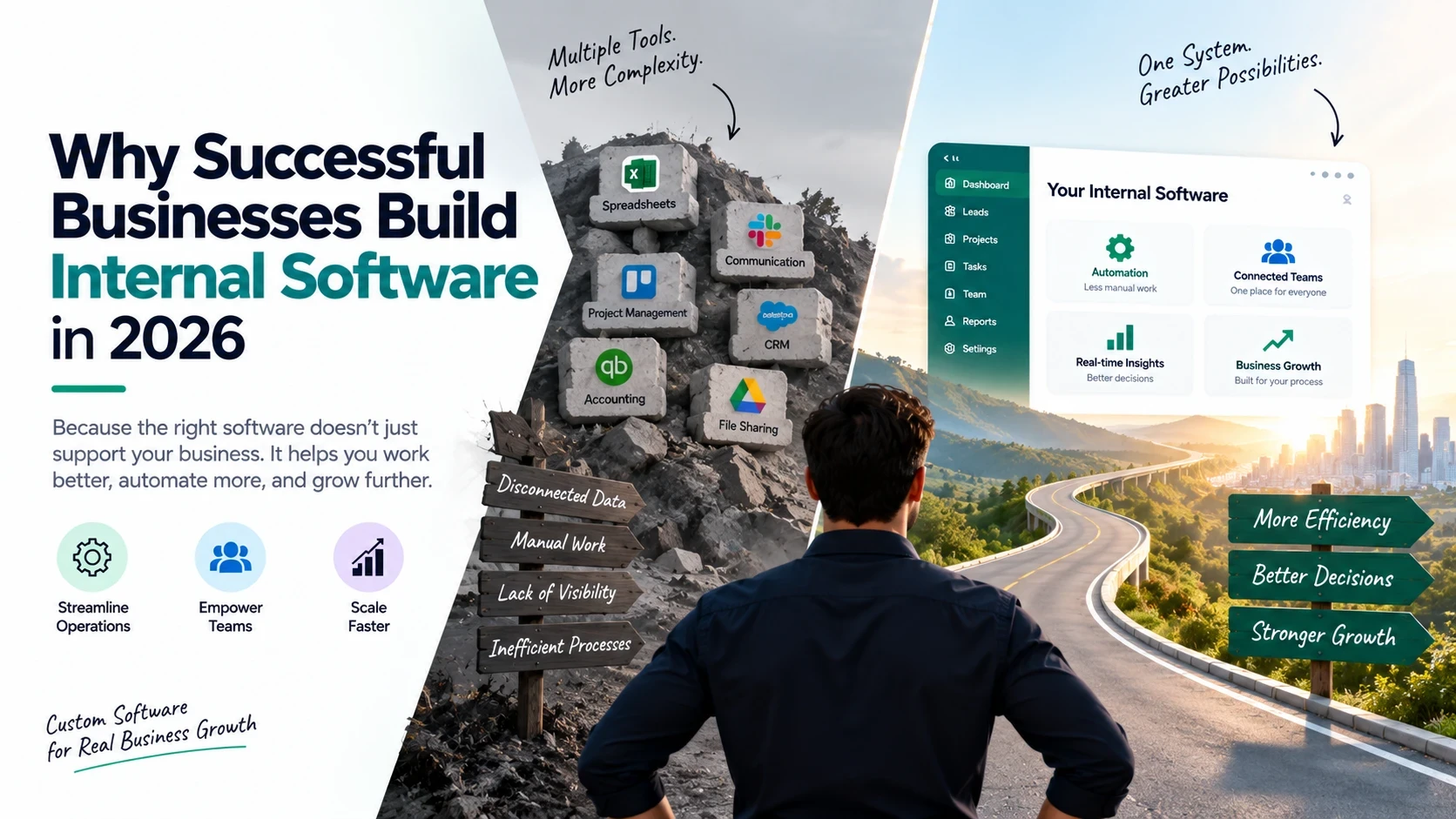
Why Successful Businesses Build Internal Software in 2026
Most businesses start by using software that already exists.
They use spreadsheets for tracking, accounting software for finances, CRM platforms for sales, project management tools for operations, messaging apps for communication and several other tools to keep the business running.
That works well in the beginning.
But as a business grows, something often happens:
The business starts adapting its processes to the software instead of the software adapting to the business.
Employees maintain multiple spreadsheets. Teams switch between different platforms. Managers ask for reports that require manual data collection. Important information gets duplicated across systems.
This is one reason successful and growing businesses eventually start investing in internal software.
Internal software is designed specifically around the company's workflows, requirements and operational challenges.
What Is Internal Software?
Internal software is a custom application built primarily for the employees and internal operations of a business.
It could be:
- A custom CRM
- Internal ERP
- Project management system
- Employee management platform
- Inventory system
- Sales management system
- Operations dashboard
- Internal approval system
- Business intelligence dashboard
- Custom workflow automation platform
Unlike a generic SaaS product, internal software is designed around how your business actually works.
For example, a logistics company may build an internal system that manages orders, drivers, vehicles, dispatching, payments and operational reporting in one place.
A software development company might build an internal system connecting leads, projects, developers, clients, invoices and support.
The software becomes part of the company's operational infrastructure.
1. Generic Software Cannot Fit Every Business
Off-the-shelf software is designed for a broad market.
That is its strength—and also its limitation.
A CRM may provide standard features such as:
- Leads
- Contacts
- Deals
- Tasks
- Reports
But your business may have a completely different sales process.
You might need:
Lead → Qualification → Technical Review → Proposal → Negotiation → Contract → Project
A generic CRM may force you to modify your workflow to fit its predefined structure.
Internal software works differently.
You define the workflow first, and the software is built around it.
Your business process becomes the foundation of the software.
2. Internal Software Reduces Repetitive Work
Growing businesses often have employees performing repetitive tasks every day.
For example:
- Copying data between spreadsheets
- Sending follow-up reminders
- Creating reports
- Assigning tasks
- Updating customer records
- Checking payment status
- Sending notifications
- Approving requests
These tasks may individually take only a few minutes.
But when hundreds of such tasks happen every week, the accumulated cost becomes significant.
Internal software can automate many of these activities.
For example:
New lead received → Lead automatically assigned → Follow-up task created → Salesperson notified → Customer communication triggered
The employee can focus on the actual sales conversation instead of administrative work.
3. It Connects Different Departments
One of the biggest problems in growing businesses is disconnected information.
Sales may use one system.
Accounts may use another.
Operations may maintain spreadsheets.
Management may rely on manually prepared reports.
This creates information silos.
Internal software can connect these processes.
For example:
Sales closes a deal
↓
Project is automatically created
↓
Operations receives the requirements
↓
Accounts receives billing information
↓
Management can track project progress
Instead of every department maintaining separate information, everyone works from the same system.
4. Management Gets Better Visibility
Business owners and managers need answers to important questions.
- How many leads are currently active?
- Which salespeople are performing best?
- How many projects are delayed?
- Which customers have outstanding payments?
- How much revenue is expected?
- Which tasks are overdue?
- Which department is facing a bottleneck?
If the information is spread across spreadsheets and different applications, answering these questions can take hours.
Internal software can bring important business information into centralized dashboards.
This allows management to make decisions based on current operational data instead of manually collected reports.
5. It Standardizes Business Processes
As a company grows, employees may start performing the same process differently.
One salesperson follows up after two days.
Another follows up after a week.
One manager approves requests through email.
Another uses WhatsApp.
One employee maintains a spreadsheet while another maintains a different version.
This creates inconsistency.
Internal software can standardize these processes.
For example:
New lead → Assigned within 5 minutes → First follow-up → Proposal → Negotiation → Closed
Everyone follows the same workflow.
This makes the business less dependent on individual working styles.
6. Internal Software Can Scale With the Business
The software that works for a company with 10 employees may not work for a company with 100 employees.
As the business grows, requirements change.
You may need:
- More users
- More departments
- Advanced permissions
- New workflows
- More integrations
- Better reporting
- Automation
- Mobile applications
- Customer portals
- API integrations
With generic software, you may have to wait for the vendor to introduce the functionality you need.
With internal software, the system can evolve as your business evolves.
This doesn't mean every feature should be built from day one.
Instead, the system can be developed progressively as the business's requirements become clearer.
7. Your Internal Software Can Become a Competitive Advantage
Two companies can have similar employees, similar products and similar customers.
But one company may operate significantly more efficiently because its internal processes are better.
Imagine a company where:
- Leads are automatically assigned
- Quotes are generated quickly
- Projects are created automatically
- Customers receive automatic updates
- Managers have real-time dashboards
- Payment reminders happen automatically
- Internal approvals happen digitally
The company can respond faster while spending less time on administrative work.
Over time, these operational advantages can become a competitive advantage.
Software doesn't only support the business. It can become part of how the business competes.
8. You Gain More Control Over Your Data
When information is spread across multiple third-party platforms, businesses have less control over how that information is structured and accessed.
Internal software can provide greater control over:
- Data structure
- User permissions
- Business workflows
- Reports
- Integrations
- Access policies
- Data storage
This can be particularly valuable for businesses handling sensitive operational or customer information.
The goal isn't necessarily to eliminate every third-party tool.
Instead, businesses can decide which systems should remain external and which processes deserve their own internal platform.
But Should Every Business Build Internal Software?
No.
Custom software isn't automatically the right answer.
If an existing SaaS product solves your problem efficiently and at a reasonable cost, there may be no reason to build something from scratch.
Internal software becomes more attractive when:
- Your processes are highly specific
- Employees perform repetitive manual work
- Multiple departments need shared information
- Existing software doesn't support your workflows
- You maintain many spreadsheets
- You use several disconnected systems
- Reporting requires significant manual effort
- Your business is growing rapidly
- Existing software requires expensive workarounds
The decision should be based on business value, not simply the desire to have custom software.
Build Only What Your Business Actually Needs
Another common mistake is trying to build a massive system immediately.
A better approach is to start with the biggest operational problems.
For example:
Phase 1
Build:
- Lead management
- Sales pipeline
- Customer management
- Basic reporting
Phase 2
Add:
- Project management
- Automation
- Invoicing
- Notifications
Phase 3
Add:
- Advanced analytics
- Mobile applications
- External integrations
- Advanced workflows
This allows the business to start receiving value earlier while the system evolves alongside its requirements.
Internal Software Isn't Just About Technology
The most important part of building internal software happens before development begins.
You first need to understand:
How does the business currently operate?
Then identify:
- Bottlenecks
- Repetitive tasks
- Manual processes
- Communication gaps
- Data duplication
- Reporting problems
- Approval delays
- Areas where employees lose time
Only then should you decide what the software needs to solve.
A poorly designed custom system can simply digitize a bad process.
A well-designed system can improve the process itself.
When Should Your Business Consider Internal Software?
Ask yourself these questions:
Are employees spending too much time on repetitive administrative work?
Are you maintaining multiple spreadsheets for important operations?
Do different departments use disconnected systems?
Does management struggle to get accurate reports quickly?
Are existing software tools forcing you to change your processes?
Are you paying for several tools that don't communicate with each other?
Do you have workflows that are unique to your business?
If you answered yes to several of these questions, it may be time to evaluate whether internal software could create a meaningful business advantage.
Final Thoughts
Successful businesses don't necessarily use more software.
They use the right software for the right problems.
Off-the-shelf applications are excellent for many common business needs. But when a company's workflows become complex, specialized or difficult to manage with generic tools, internal software can provide a different level of control and efficiency.
The objective isn't to build software simply because it is custom.
The objective is to build a system that helps your business:
Work better → Automate more → Make better decisions → Scale efficiently
At NEOQOM, we help businesses turn their unique processes into practical internal software solutions designed around the way they actually operate.
Because your business shouldn't have to change the way it works just to fit the limitations of a software product.